By no means exhaustive, the following list includes articles published by Teachers & Writers Magazine written by and/or about Latinx, Latin-American, and Hispanic writers.
Lesson Plans & Resources
“Banned Book Writing Prompts: The House on Mango Street by Sandra Cisneros” by Theresa Dietrich
Banned book writing prompts for The House on Mango Street by Sandra Cisneros.
“Banned Book Writing Prompts: The Poet X by Elizabeth Acevedo“ by Matthew Burgess
Banned book writing prompts for Elizabeth Acevedo’s contemporary YA novel The Poet X.
“Completing the Character Puzzle with Vignettes” by Jennie Weng
Inspired by the story “Geraldo No Last Name” by Sandra Cisneros, this lesson plan engages students in character analysis and drafting character vignettes.
“Everybody Dreams: Writing List Poems on the Dreamlife of Others, Objects, and Ourselves” by Joanna Fuhrman
Dreams are central to this multifaceted lesson plan, which includes a reading of Chilean poet Nicanor Parra’s list of dreams.
“Experimental Translation” by Olaya Barr
The art of translation becomes a creative writing exercise in this lesson plan centered on a poem by Spanish poet Gustavo Adolfo Bécquer.
“Gathering the Split Halves of Yourself” by Miranda Ramírez
A lesson plan designed to inspire students towards creative control in their poetry and everyday lives.
“Keep Your Hands Moving” by Luis Jaramillo
Luis Jaramillo reveals the hidden value of drawing in a writing class.
“Let’s Play: Writing for the Stage” by Tisha Marie Reichle-Aguilera
Tisha Marie Reichle-Aguilera returns to her hometown to bring drama back to the community—drama writing that is.
“Mis Antepasados / My Ancestors” by Alexandra Newton Rios
Alexandra Newton Rios shares how creative writing can be used to spark language learning.
“My Self-Portrait / My Secret Self-Portrait” by Sheila Maldonado with Azka Anwar
This lesson plan is inspired by the poem “Datos Personales” by Nicaraguan/Salvadoran poet Claribel Alegria.
“Odes in Science: A Lesson Plan” by Bertha Rogers
A lesson plan based on a reading of Pablo Neruda’s “Ode to Salt.”
“Origin Story Lesson Plan Using ‘Afro-Latina’ by Elizabeth Acevedo” By Candace Iloh
A lesson plan geared toward exploring identity, inspired by the poem “Afro-Latina” by Elizabeth Acevedo.
“Overlooked and Under-Read: Latin American Writers Beyond Magical Realism” by Olaya Barr
Olaya Barr presents a list of favorite fiction writers “that present a multi-faceted prism of literature and histories.”
“Sensory Details and Sandra Cisneros’ ‘Abuelito Who‘” by Alba Hernandez
In this lesson, T&W teaching artist Alba Hernandez focuses on teaching students to use vivid details to create a linguistic picture of a special person or pet in a way that is captivating and original.
“Serious Play” by Asari Beale
Understanding T&W poetry writing programs and how they create liberated spaces for the making of poetry.
“Trouble the Waters: Caribbean and Diasporic Writers Resource” by Jehan Roberson
Recommended writers of the Caribbean diaspora, including Puerto Rican poet Julia de Burgos and Cuban poets Nancy Morejón and Carmen Maria Machado.
“What I Got: Nina Simone and the Freedom to Write and Dance” by Alba Delia Hernández
Faced with students who wouldn’t write, Alba Delia Hernández turns to Nina Simone’s “Ain’t Got No/I Got Life” to shake up the classroom.
“Where Snow Falls Every Few Pages: Rosa Alcalá on David Shapiro” by Rosa Alcalá
For our Teachers on Teachers series, Rosa Alcalá shares how poet and professor David Shapiro taught her about art, poetry, and life and helped her see that she has a voice worth listening to.
“Writing with Children After the Fires” by Phyllis Meshulam
Meshulam describes writing with children following massive wildfires in California, including a lesson inspired by Juan Felipe Herrera’s poem “Five Directions to My House.”
Interviews
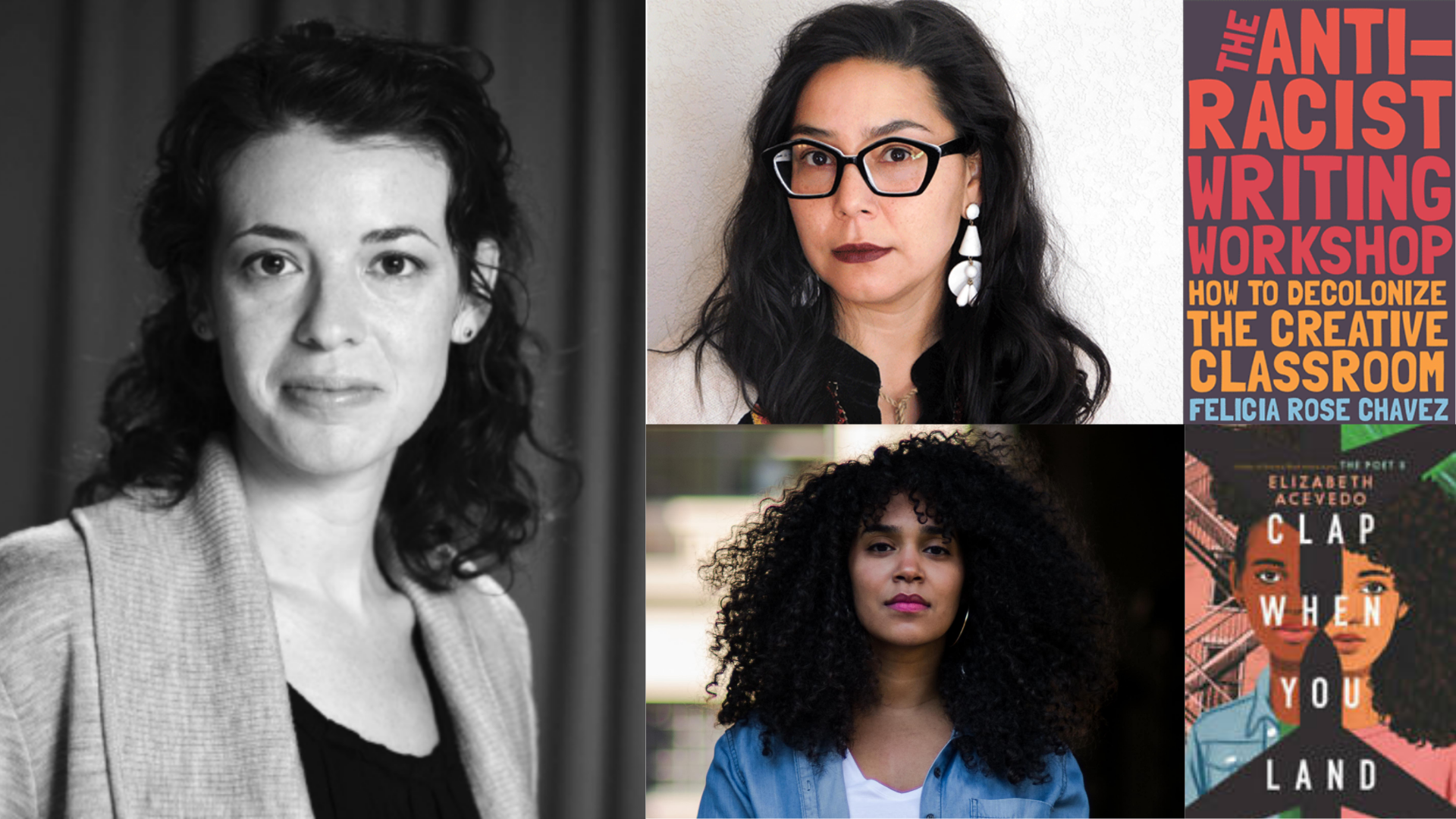
“The Anti-Racist Writing Workshop: An Interview with Felicia Rose Chavez” by Amanda Volel
In this interview, Felicia Rose Chavez and poet and T&W writer Amanda Volel discuss Chavez’s new book The Anti-Racist Writing Workshop: How to Decolonize the Creative Classroom and how to incorporate anti-racist practices and mindfulness into your workshop classroom.
“The Braver We Become: An Interview With Elizabeth Acevedo” by Matthew Burgess
Poet and best selling author Elizabeth Acevedo talks with T&W writer Matthew Burgess about her journey with writing, education, and teaching.
“A Home at the Nuyorican: An Interview with Lois Elaine Griffith” by Jehan Roberson
Jehan Roberson interviews Lois Elaine Griffith, who has stories to share as an educator, poet, performer, visual artist, and the founding poet of the Nuyorican Poets Cafe working with Miguel Algarín––a space of diasporic stories from Latin-American, Brown, Black, queer and other marginalized folk across New York City.
“A Hunger For Stories: An Interview with Quiara Alegría Hudes” by Carla Ching
Carla Ching interviews Quiara Alegría Hudes, an award-winning author of plays, musicals, screenplays, and other literary works. In her work, Hudes combines intellectual curiosity with a humanistic vision to tell new American stories. In this interview, we get insight into the role Hudes plays as a mentor at Philadelphia Young Playwrights.
“Knowledge That Speaks in Difficult Times: An Interview with Sharon Mesmer” by Talia Aharoni
Poet Sharon Mesmer describes several Latin-American women poets who were sources of inspiration for a manuscript-in-progress, including Eunice Odio, Violeta Parra, and Delmira Augustini.
“The World Around Us: Balancing Opposing Forces, a Conversation with Ruben Quesada” by Joshua Garcia
Joshua Garcia speaks with Ruben Quesada about contradiction, balance, ekphrasis, and Quesada’s new poetry collection Brutal COmpanion.
Essays
“Hunger: Inspiration from Nicolás Guillén’s ‘El Hambre‘” by Sarah Dohrmann
Middle school teacher Sarah Dohrmann shares her experiences introducing and teaching Cuban poet Nicolás Guillén’s work to her sixth-grade poetry class, celebrating the power of Spanish in the New York City classroom.
“Making Sense of It All: High School Poetry in the Age of Zoom” by Paola Capó-García
Paola Capó-García is a poet and educator from San Juan, PR. In this essay, she addresses the challenges of virtual instruction by having her high school students do a deep dive into poetry, allowing them the time and space to explore their own poetic voices.
“Quality, Not Quantity: Writing Quintillas in Middle School Spanish” by Sydney Lumbreras Clifton
Sydney Clifton, middle school language educator, recounts her experience introducing quintilla poetry forms to her middle school Spanish class––intersecting language education and creative writing.
“Where Does It Take You?: Using the Poetry of Paz, Pacheco, Gutierrez, Blanco, and Deltoro as Models” by Naomi Sahib Nye
In this T&W archive article from 1997, Nye writes about her experience teaching in San Antonio, where she and her students closely read poetry by Latinx poets to inspire their writing processes, attentiveness to detail, and perceptions of their neighborhoods.
Additional Resources
“Poems for Hispanic Heritage Month” by the Academy of American Poets
A collection of poems, essays, and resources on Hispanic Heritage Month from the Academy of American Poets.
“U.S. Latinx Voices in Poetry: Exploring Latino/a American Poetry and Culture” by the Poetry Foundation
“Adding Latinx Poetry to Your Curriculum: Using Poems to Discuss More than Poetry in the Classroom” by Lupe Mendez
Published by the Poetry Foundation.
Letras Latinas Blog 2, the University of Notre Dame’s Institute for Latino Studies
Letras Latinas Blog 2 (LLB2) offers insight and commentary on contemporary Latinx letters, especially poetry.

Teachers & Writers Magazine is published by Teachers & Writers Collaborative as a resource for teaching the art of writing to people of all ages. The online magazine presents a wide range of ideas and approaches, as well as lively explorations of T&W’s mission to celebrate the imagination and create greater equity in and through the literary arts.